Selling silver cutlery: what counts?
A canteen of cutlery from an inheritance, a drawer full of spoons and forks that look like silver. If you want to sell silver cutlery, you first want to know exactly what you have. The answer is usually on the back of the handle, in a small number.
If it says 800, 835 or 925, it is probably solid silver, and then the weight of the pure silver counts. If it says a number such as 60, 90 or 100, it is silver plated: a thin layer of silver on another metal. De Munter does not buy silver plated cutlery, you get it back. Silver table knives do not count, because their handle is filled.
Recognising solid silver by the hallmark
On solid silver the content is given in thousandths: the weight of the pure silver compared to the weight of the whole piece. 800 therefore means 80 percent silver, 925 means 92.5 percent.
In Belgium the legal silver standards today are 925 and 835. The Belgian hallmark is an oval with the number inside, sometimes preceded by the letters AG. Since 1990 it has also come with a maker’s mark in the shape of a small barrel. On older Belgian silver you also find 800 and 900. Much cutlery comes from abroad, and every country has its own mark:
| Country | Mark | Standard on cutlery |
|---|---|---|
| Belgium | Oval with the number | 925 or 835, on older silver also 800 or 900 |
| France | Head of Minerva with a 1 or a 2 | 1 = 950, 2 = 800 |
| Germany | Crescent moon and crown | 800 or higher |
| Netherlands | Lion | 925 or 835 |
| United Kingdom | Lion passant | 925 (sterling) |
An 800 on cutlery therefore often points to German, French or older Belgian silver.
No hallmark? That says nothing yet
With old silver a missing hallmark is not always suspicious. In Belgium, state assaying has not been compulsory since 1869, and antiques do not need to carry a legal hallmark today. Conversely, a hallmark is an indication, not proof. Only a test gives certainty.
Silver plated cutlery: what does 90 or 100 mean?
Silver plated cutlery carries a number too, but it is not a silver content. It is the number of grams of silver for a dozen table couverts, spread as a thin layer over the cutlery. You often see 60, 90 or 100.
An old guarantee certificate kept by De Munter shows it in black and white. It came with a box of silver plated cutlery sold in 1960, and states in Dutch: "Verzilvering op basis van 100 gr. per dozijn tafelcouverts". In English: silver plating based on 100 grams per dozen table couverts.
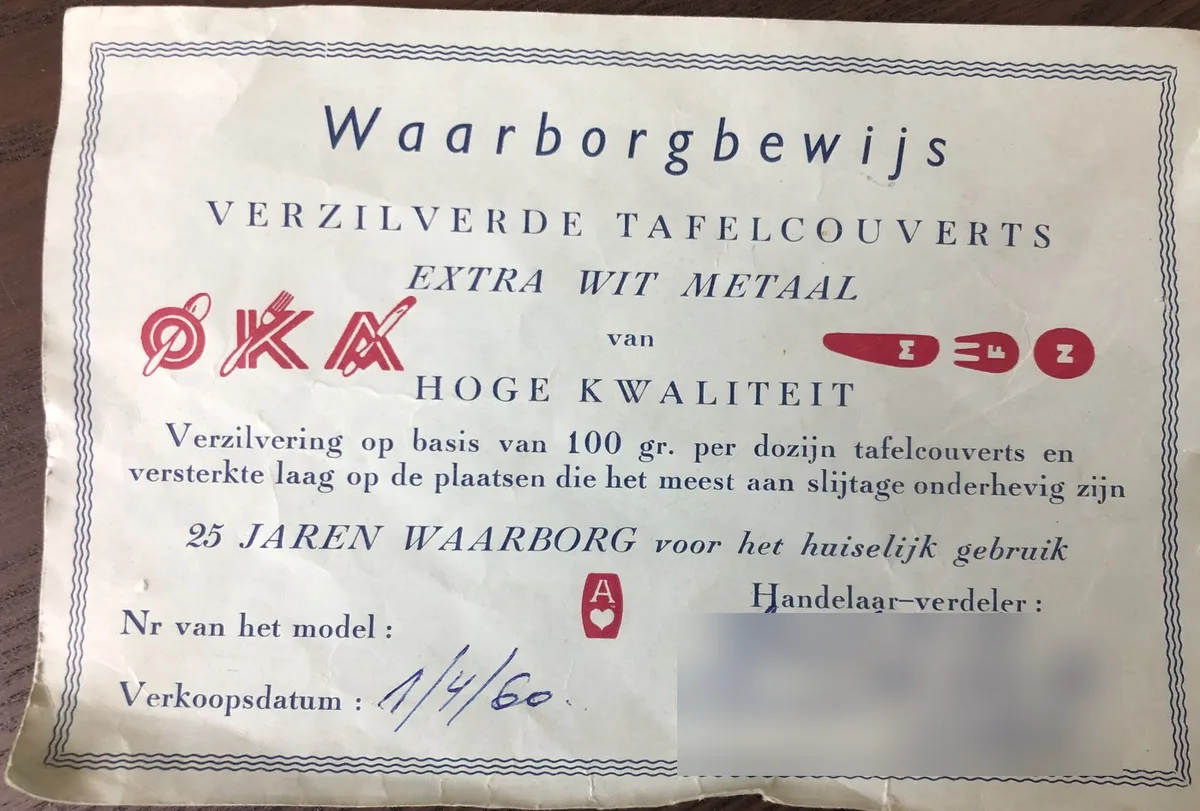
100 grams
of silver per dozen table couverts, spread as a thin layer. Not a silver content.
That silver lies as a thin layer on a core of another metal, often nickel silver, also called alpaca: an alloy of copper, nickel and zinc, without any silver. Silver plated cutlery is also called silver plate. On English cutlery you often see the letters EP or EPNS.
So there really is silver on it, but little. Separating it from the other metal is a lot of work and only pays off with large quantities, not for one box of cutlery. That is why De Munter does not buy silver plated cutlery, and you get it back.
Silver turns black because of sulphur in the air. A thin, dark layer forms: tarnish. Silver plated cutlery also has real silver on the outside, so it tarnishes just as much. Turning black only shows that there is silver on the surface, not that the cutlery is solid silver. For that, look at the hallmark, and a test gives certainty.
Christofle, Wiskemann and other brands
A brand name does not in itself tell you whether something is silver plated. Christofle of Paris is best known for silver plated ware, but also made solid silver. Wiskemann, founded in Brussels in 1872, made both solid silver and silver plated ware. With both brands silver plate is the most common, but the number decides, not the name.
Why silver knives do not count
The handle of a silver table knife is hollow. It consists of two halves soldered together, and is filled with materials such as plaster, wax, wood, resin or pitch, which holds the blade. Belgian law expressly allows this: for handles of silverware, such a filling is unavoidable for technical reasons. The blade itself is steel, because silver is too soft to hold an edge.
The weight of that filling cannot be worked out. That is why De Munter does not buy table knives with a filled handle. Small knives made entirely of silver, such as fruit, fish or butter knives, we do buy, after a test, at silver value. Spoons, forks and serving pieces in solid silver simply count.
What is your silver cutlery worth?
With solid silver only the pure silver counts. The weight times the content gives the fine silver weight, and that times the silver rate per gram gives the value of the material. Our offer is based on that.
- Weighing All pieces that count go on the scale together. Table knives with a filled handle stay aside.
- Determining the content The hallmark gives an indication, a test gives certainty.
- Calculating the pure silver Weight times content. A kilo of cutlery hallmarked 800 contains 800 grams of pure silver.
- Applying the daily rate That pure silver times the silver rate of the day gives the value of the material.
The silver rate changes every day. Which rate applies today, you can see on our page with the current gold and silver rate.
Brand, canteen or monogram?
For the silver value only the silver counts. A well known brand, a complete canteen, an engraved monogram or the age change nothing about the weight of the pure silver.
Selling silver cutlery: how to go about it
- Look at the number first. 800, 835 or 925 points to solid silver, 60, 90 or 100 to silver plate.
- Do not rely on the brand name. Christofle and Wiskemann made both silver plated and solid cutlery.
- Put the table knives aside. A filled handle does not count. Small knives made entirely of silver do count.
- Do not polish. Polishing changes nothing about the silver value.
- If in doubt, show us everything. Silver plated cutlery you get back.
Do you have a box of cutlery and are you unsure whether it is solid or silver plated, or what it is worth today? Have it valued without obligation. We test the silver, weigh it in front of you and show you the current silver rate, step by step. We come to your home, or you come to a visiting day in your municipality.